You are currently viewing What is graphic design?

What is graphic design?

Spread the love
What is graphic design?

Simply put, graphic design is a creative process that combines visual elements with strategic thinking. It's not just about making shapes look good; it's also about using images to solve problems.

For example:

  • A logo helps people recognize the brand instantly.
  • A brochure provides clear and structured information about a company's services.
  • A social media design engages users and motivates them to take action.

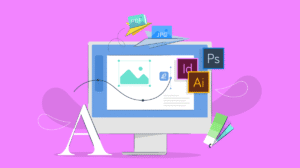
Graphic designers create captivating, educational, and impactful images using Adobe Photoshop, Illustrator, Canva and many other programs. Adobe Photoshop, Illustrator, Canva and numerous other programs are used by graphic designers to produce images that captivate, educate, and impact viewers.
1. Fundamental Elements and Concepts of Graphic Design

Understanding the basics is the first step towards becoming a proficient designer.  Graphic design has certain elements (building blocks) and principles (rules) that make a design meaningful, balanced and appealing.

Essential Components of Graphic Design
i. Line

Lines help divide space, form shapes, and guide the viewer’s attention.  They can be simple, decorative, thin, thick, curved, or straight.

ii. Form

Each design is made up of shapes—geometric shapes (circles, squares), organic shapes (naturally flowing shapes), or abstract shapes.

iii. Colour

Color sets the tone and mood of a design. A bright color creates excitement, while a subdued color creates a sense of calm. Designers use color psychology to influence their audience.

iv. Typography

Typography is the arrangement of fonts and text.  When typography is done well, the content is readable and looks good.

v.Texture

Texture adds depth, making designs feel realistic.Rough, smooth, patterned, or even digitally created are all possible.

vi. Space

In particular, empty space allows the design to “breathe.” This prevents a cluttered look and draws attention to specific areas.

vii. Images and Drawings

Images, icons, and illustrations enhance the message and make the design more attractive and understandable.

Fundamentals of Graphic Design

These principles are like guidelines that help designers create visually meaningful and balanced work.

i. Stability

In order to make the design appear stable, balance aims to distribute components evenly.  It may be asymmetrical (visually balanced but uneven) or symmetrical (equal).

ii. Different

Important things are highlighted by contrast.  It can be made with a variety of colors, sizes, fonts, and shapes.

iii. Alignment

A properly aligned design is clean, well-organized, and polished. Everything should appear perfectly connected and arranged.

iv. Organization

The most important components are highlighted by the hierarchy.For example, the body text is usually smaller than the heading.

v. Repeating

Repeating fonts, colors, or shapes creates consistency and fortifies the main idea.

vi. Proportion

In order to ensure everything looks rational and coherent, proportion maintains the correct size relationship among elements.

vii. Movement

Movement guides your eyes across the design—from the headline, to the image, and then to the call-to-action—so everything feels connected.

viii. Unity

Unity pulls the whole design together.Every part feels like it belongs and fits with the rest.

2.Types of Graphic Design

In both digital and print, there are few main types:

i. Identity design and branding

It’s all about how a brand looks and feels. Logos, color palettes, branding, business cards, packaging—the visual stuff that gives a company its personality.

ii. Marketing and advertising design

Here, the main goal is to catch people’s attention. Designers create posters, brochures, flyers, banners, ads for social media, billboards—the works.

iii. UI and UX design

User Interface (UI) designers handle the look and layout of apps and websites, ensuring everything is clean and easy to use. User Experience (UX) designers focus on how it all works, making the experience simple so people can enjoy using it. This happens mostly on digital platforms.

iv. Print Design

Print designers work on things you can actually hold – like magazines, newspapers, books, printing, product labels and more.

v. Web & Social Media Graphics

This covers Infographics, YouTube channel art, Instagram posts, website banners, thumbnails—the all stuff you see scrolling or surfing online.

vi. Animation and Motion Graphics

This covers GIFs, explainer videos, animated logos, graphics for video editing—all that eye-catching, moving content.

vii. Environmental Design

These designers focus on real-world spaces.They handle visuals for events, wall graphics, signboards, exhibition displays—basically.

viii. Design and Illustration

Some designers creating illustration and original artwork for books, ads, merchandise, or websites. It’s about bringing ideas to life through drawing.

3. Graphic Designers typically work on?

Graphic designers does a lot of work, and their day-to-day really depends on what they specialize in.Here’s a quick look at some of the things they do:

A. Logo Design

They come up with unique symbols or icons that capture a brand’s vibe.

B. Branding

Designers set the tone for brands—choosing color palettes, picking out fonts, and creating full brand guidelines.

C. Social Media Content

Think banners, stories, ads, reel covers, and posts for places like Facebook, Instagram, LinkedIn, and YouTube.

D. Promotional Materials

They design ads, business cards, flyers, brochures, posters, and product catalogs—the whole toolkit.

E. Web and App UI

Designers build layouts, buttons, icons, and entire user interfaces for websites or apps.

F. Packaging

They handle labels, wrappers, product boxes—anything that dresses up a product.

G. Print Publications

From newspapers to magazines, book covers to newsletters, they design the layouts that make print pop.

H. Visuals for Businesses

Menu cards, billboards, signage, presentation slides, email templates—basically, all the visuals companies need.

I. Custom Art & Illustration

Some designers draw or paint—digitally or by hand—for branding, books, or merchandise.

J. Motion Graphics

In this animated explainers, logo reveals, and lively social media posts are covers.

Conclusion

Graphic design makes the way brands talk to the world that moves fast and loves visuals especially.Every color, font, and shape on a package or a logo, someone picked those on purpose.

If you’re new to this, learning these fundamentals sets you up to create sharp looks work that is actually matters.

Leave a Reply